Case Law
The Shift in Apportionment: Analyzing the Recent En Banc Decisions
The landscape of apportionment in California workers' compensation law is undergoing a subtle but significant transformation.

Chris Lyle
Co-Founder & CEO
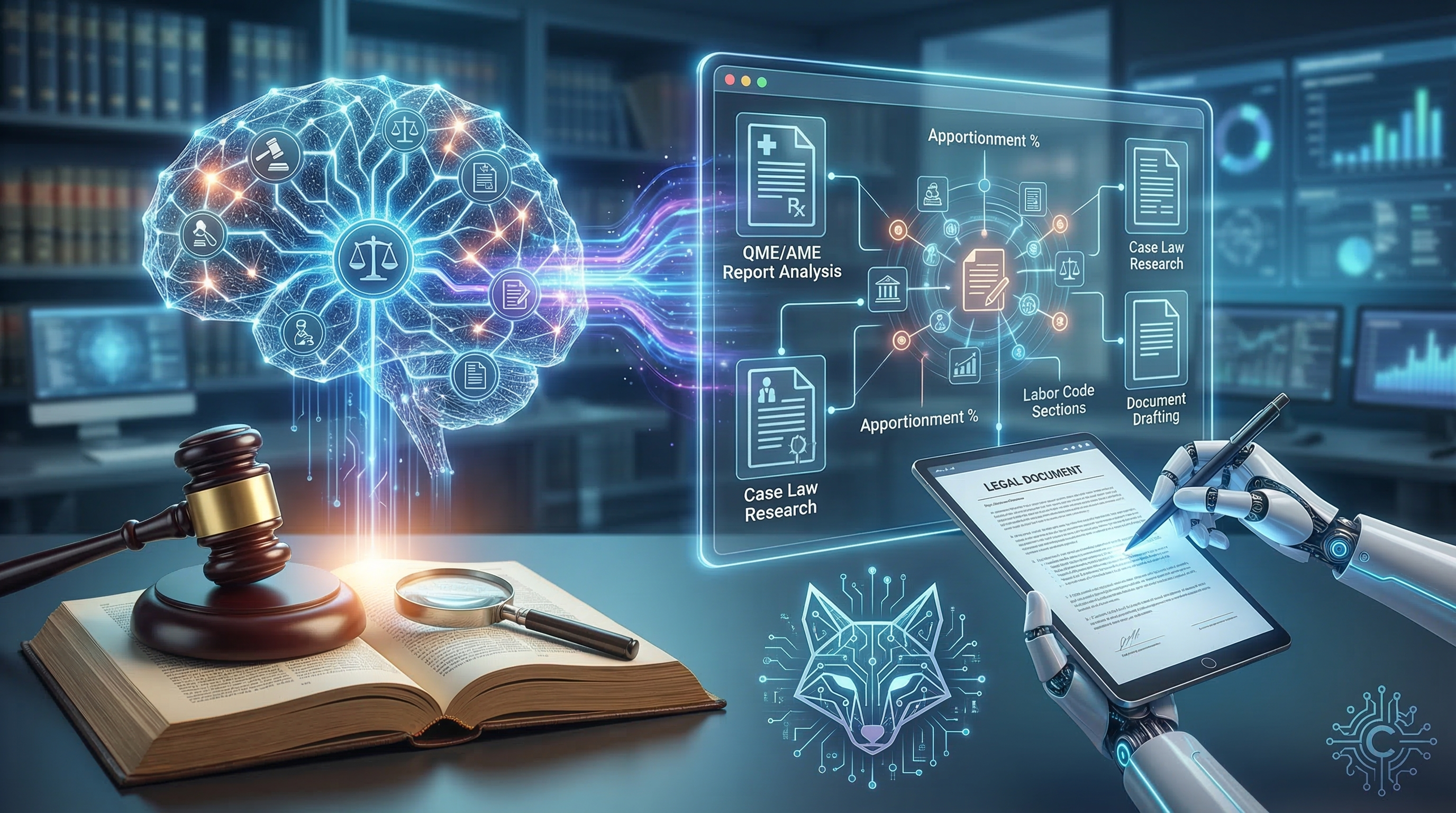
The workers' compensation defense attorney who still manually cross-references 300-page QME reports and runs case law searches on generic tools isn't just working harder — they're losing cases to the firm that isn't. That's not hyperbole. It's the new competitive reality of WC defense practice in 2026.
AI has moved from boardroom buzzword to courtroom-ready infrastructure. Across workers' comp defense, claims operations, and applicant-side litigation, purpose-built artificial intelligence tools are collapsing the time it takes to research apportionment arguments, flag IMR inconsistencies, identify controlling En Banc decisions, and draft Labor Code-compliant documents. The firms gaining decisive advantages in 2026 aren't the biggest — they're the fastest and most precisely armed [1].
This article breaks down exactly how AI is transforming workers' compensation defense practice — from QME/AME report analysis and case law research to document drafting and claims strategy — and why practitioners who treat AI as optional are already falling behind.
A single complex workers' compensation case file can run deep: 300-page QME reports, AME panel findings, years of medical records, deposition transcripts, prior WCAB decisions, and a trail of correspondence that no associate has ever fully read end-to-end. The manual review burden is real, and it's compounding across every open file on your docket.
Generic legal research tools like Westlaw and Lexis are not trained on workers' comp nuance. They miss jurisdiction-specific Labor Code interpretations, WCAB panel decisions that never make it into formal reporters, and En Banc authority that controls outcomes in California WC litigation. Running an apportionment argument through a general-purpose database and hoping it surfaces the right Hikida or Benson analysis is not a research strategy — it's a coin flip [2].
Claims adjusters and legal ops leads at self-insured employers and TPAs face the same throughput bottleneck on the operations side: too many open files, not enough analytical bandwidth, and reserve decisions being made on incomplete pictures of medical and legal exposure.
The compounding cost of missed citations is not abstract. One overlooked apportionment case under Labor Code §4663 or a missed Ogilvie adjustment argument can shift a settlement by tens of thousands of dollars. Multiply that across a high-volume WC docket and the status quo isn't just an operational inconvenience — it's a measurable competitive liability.
AI is not monolithic, and the most dangerous mistake a WC practitioner can make right now is treating it like it is. General-purpose AI assistants — ChatGPT, generic legal AI chatbots — are trained on the internet. Workers' compensation law, particularly California WCAB practice, is a highly specialized domain with its own evidentiary standards, procedural posture, and body of controlling authority that general models simply do not know well enough to be trusted [3].
The highest-ROI AI applications in WC defense today are specific: case law research, QME/AME report analysis, document drafting, cross-referencing medical findings, and settlement valuation support. Vertical AI platforms purpose-built for workers' compensation law are delivering real results in all five categories. Here's where the rubber meets the road.
Vertical AI trained on WCAB panel decisions, En Banc rulings, and California Labor Code sections surfaces controlling authority faster and more accurately than any generic tool — and the delta is not marginal. It's the difference between a half-day associate research task and a 60-second query result that includes the right apportionment precedent, properly cited.
Finding apportionment precedents under Labor Code §4663 and §4664, navigating Hikida arguments and their limits, identifying Benson exceptions — this requires institutional knowledge that junior associates spend years accumulating. Vertical AI encodes that knowledge and retrieves it on demand [2].
The leveling effect here is significant. Solo practitioners and small firms can now run research with the depth and speed previously available only to large firms with deep associate benches. A three-attorney WC defense shop competing against a 30-attorney firm is no longer outgunned on research velocity — they're running the same search in the same seconds.
Real-world scenario: identifying a controlling apportionment case that changes a defense posture in under 60 seconds versus a half-day associate research task is not a hypothetical. It's what AI-equipped WC practitioners are doing right now, and it's changing which arguments make it into trial briefs and which ones never get found.
QME and AME reports are the evidentiary backbone of most WC defense strategies. They're also dense, technical, and voluminous — exactly the kind of document that eats attorney time and creates risk when reviewed under deadline pressure.
AI can extract key findings, flag inconsistencies, identify deviations from MTUS guidelines, and cross-reference prior medical opinions across a case file in seconds [4]. Defense counsel and claims adjusters can instantly surface the specific paragraphs that support or undermine apportionment arguments, work restrictions, or causation positions — without reading page 47 to find them.
The competitive advantage is concrete: when opposing counsel is still working through a 280-page AME report manually, your AI-equipped team has already built the cross-examination outline, flagged the three paragraphs where the QME's causation opinion contradicts the prior treating physician's findings, and identified the MTUS deviation that undermines the recommended treatment.
Settlement letters, trial briefs, MSCs, DORs, and C&R agreements follow predictable structures. Every WC attorney has written hundreds of them. The drafting process is not intellectually demanding — it's time-consuming, and it pulls cognitive energy away from strategy.
AI can generate compliant first drafts anchored to case-specific facts, trained on WC-specific language and Labor Code citations, in minutes rather than hours. The productivity multiplier for attorneys handling high-volume WC dockets is significant. More importantly, AI trained specifically on California WC practice reduces the risk of boilerplate errors and jurisdiction-specific compliance gaps that generic templates routinely produce.
Let's put the replacement fear to rest directly: AI does not adjudicate facts, exercise professional discretion, or stand up in front of a WCJ and credibly advocate for a position. What it does is compress the time attorneys spend on low-leverage tasks — document review, legal research, repetitive drafting — so they can spend more time on high-leverage tasks: strategy, negotiation, trial preparation, and the nuanced credibility assessments that only experienced practitioners can make.
The ratio of low-leverage to high-leverage time in a WC defense practice is currently inverted for most attorneys. AI flips it. Defense counsel who previously spent 60% of their case preparation time on research and document review can redirect that time to the strategic analysis that actually moves settlement value and wins hearings.
What stays irreducibly human: credibility assessment of medical experts, litigation strategy under genuine uncertainty, client relationship management, and courtroom advocacy. AI doesn't replace any of that. It removes the friction that prevents attorneys from doing it at full capacity.
The new competitive benchmark is not effort — it's output quality per hour. AI resets that benchmark decisively, and defense attorneys using it aren't less rigorous. They're more precise, better prepared, and faster to dispositive arguments than their non-AI-equipped counterparts [5].
The transformation isn't limited to litigation. Claims adjusters and legal ops leads at self-insured employers and TPAs are navigating a parallel disruption — AI is changing how reserves are set, how vendor panels are managed, and how litigation strategy is coordinated with defense counsel [4].
AI-assisted file review enables adjusters to flag litigation risk earlier and with greater precision, improving reserve accuracy and reducing late-developing exposure that blindsides finance teams at year-end. Cross-referencing medical findings across large claim files — previously a manual, error-prone process that relied on adjuster memory and incomplete notes — becomes automated, auditable, and consistent.
The downstream effect on defense strategy is direct: when the adjuster's file summary is AI-generated and comprehensive, defense counsel enters each case with a stronger foundation. There's less time spent reconstructing the factual and medical history, and more time spent on the arguments that matter.
On the compliance and documentation side, AI-generated audit trails for claims decisions support defensibility in bad faith exposure scenarios — a growing concern for self-insured employers managing complex or high-exposure files.
Here's the central credibility threat in legal AI adoption, stated plainly: hallucinated citations. Fabricated case names. Invented Labor Code sections. Misattributed holdings that survive peer review and make it into filed documents or settlement negotiations. This is not a hypothetical risk — it has happened, and it has damaged attorney credibility and client outcomes in real cases [1].
General-purpose AI models are trained on the internet. The internet does not contain a comprehensive, reliable corpus of WCAB panel decisions. It does not accurately represent the controlling En Banc authority that governs California WC litigation. When you ask a general-purpose model to find apportionment authority under Labor Code §4664 and it confidently produces a case citation you cannot verify in any reporter or WCAB database, you have a problem — and that problem doesn't announce itself before you cite the case.
Vertical AI platforms purpose-built for workers' compensation law solve this by training exclusively on WC case law, Labor Code sections, WCAB panel decisions, and jurisdiction-specific authority. Hallucination resistance is not a feature upgrade. It is the threshold requirement for any AI tool used in a legal filing, a settlement demand, or a reserve recommendation.
How to evaluate any AI tool for WC practice: demand source transparency, citation verifiability, specificity of training data, and evidence of jurisdiction-specific coverage. If a vendor cannot tell you exactly what their model was trained on and cannot show you live citations that link back to real, retrievable sources, you're not looking at a legal AI tool — you're looking at a liability.
Not all legal AI tools are created equal, and the evaluation criteria for WC-specific practitioners are materially different from those for general litigation attorneys. The questions every WC practitioner should put to any AI vendor before adoption are direct:
Is the model trained specifically on workers' compensation case law and California Labor Code? Can it cite verifiable, real WCAB decisions — and can you check those citations in real time? Does it handle jurisdiction-specific nuance, such as California apportionment doctrine versus other states' frameworks? What is the hallucination rate, and how is it measured?
For solo practitioners and small firms, integration considerations include workflow fit, learning curve, per-seat pricing, and time-to-value. The best vertical AI platforms for WC practice are designed to deliver value in the first research query, not after a six-month implementation process.
For larger TPAs and self-insured employers evaluating the build versus buy question: purpose-built vertical platforms almost always outperform internal AI projects on accuracy and maintenance cost. The ongoing work of keeping a WC AI model current — incorporating new WCAB panel decisions, En Banc rulings, and Labor Code amendments — is a specialized capability that internal IT teams are not positioned to maintain at the required level of legal precision.
Red flags to walk away from: tools that confidently cite cases you cannot verify, products that claim to cover all practice areas equally well, and platforms that lack any transparency about their training data sources [3].
The non-negotiables for a WC-specific AI research platform are clear. Proprietary training on WCAB decisions, En Banc authority, California Labor Code sections, and jurisdiction-specific panel decisions is the baseline — not a premium feature. Hallucination-resistant architecture with verifiable citations means every output links back to a real, retrievable source you can check before you file it.
The platform should be designed around the WC practitioner workflow specifically: case law research, QME/AME analysis, document cross-referencing, and drafting support in one environment, not bolted together from general-purpose components. Speed benchmarks that matter in practice are research queries answered in seconds, and document analysis that scales to full case files without requiring manual pre-selection of which pages to upload.
If your current research workflow doesn't meet that standard, it's worth taking two minutes to Start Researching with CompFox and seeing what your case files have been missing.
In every legal market disruption, the window for first-mover advantage is real but finite. Early AI adopters in WC defense are already compressing timelines and improving case outcomes in ways that are visible — to clients, to opposing counsel, and to the claims operations teams coordinating litigation strategy [5].
The fastest firm wins is not a slogan. It's a measurable dynamic when one side can identify controlling WCAB authority before the other side has finished their Westlaw search. When one team's QME analysis is complete before the other team has flagged the MTUS deviation. When one attorney walks into MSC with a settlement valuation grounded in comprehensive cross-referenced medical and legal findings, and the other attorney is still working off incomplete notes.
The adoption curve in WC defense in 2026 looks like this: approximately 15-20% of firms are actively using vertical AI in their practice; the majority are experimenting with generic tools or haven't meaningfully started. That gap is the competitive opportunity — and it is closing [1].
The risk of waiting is not hypothetical. As AI-equipped firms lower their effective per-case cost and increase throughput, firms without AI face margin compression and, over time, client attrition from clients who notice the difference in response time, preparation quality, and case outcomes. The practitioner mandate is straightforward: adopt purpose-built AI now, or spend the next two years catching up to competitors who already have a 24-month head start.
AI is not a future trend in workers' compensation defense — it's a present-tense competitive weapon. From QME and AME report analysis to apportionment research under Labor Code §4663 and §4664, from En Banc decision retrieval to C&R drafting, purpose-built vertical AI is compressing hours into seconds for the practitioners willing to use it. The firms and adjusters who adopt now aren't just more efficient — they're better prepared, more precise, and winning on facts their competitors never found.
The firms still treating AI as a future consideration are already giving ground. The firms that adopted early are compounding their advantage with every case file they open.
Stop researching workers' comp with tools that weren't built for it. CompFox is the AI platform purpose-built exclusively for workers' compensation law — trained on WCAB decisions, Labor Code, and WC-specific authority with hallucination-resistant citations you can actually file. Start Researching with CompFox today and see what your case law has been missing.
AI is fundamentally transforming workers' compensation defense practice by automating time-intensive tasks that previously consumed billable hours and introduced research gaps. In 2026, purpose-built AI platforms are enabling defense attorneys to analyze 300-page QME and AME reports in minutes, surface controlling WCAB panel decisions and En Banc rulings in seconds, and draft Labor Code-compliant documents with greater speed and accuracy. The shift is not just about efficiency — it's about competitive advantage. Firms using vertical AI tools trained specifically on workers' comp law are identifying apportionment arguments, flagging IMR inconsistencies, and building stronger settlement strategies faster than firms relying on manual review or generic legal tools. The practitioners gaining ground are not necessarily the largest firms, but the most precisely equipped ones.
General-purpose AI tools like ChatGPT are trained on broad internet data and lack the depth required for workers' compensation defense work. California WCAB practice involves highly specialized evidentiary standards, jurisdiction-specific Labor Code interpretations, and a body of controlling authority — including panel decisions that never appear in formal legal reporters — that generic models simply do not cover reliably. Using a general AI assistant to research an apportionment argument under Labor Code §4663 or an Ogilvie adjustment carries real risk of missing critical precedent. Vertical AI platforms purpose-built for workers' comp law are trained on WCAB decisions, En Banc rulings, and California-specific statutes, making them far more accurate and trustworthy for defense practitioners.
The highest-ROI applications of AI in workers' compensation defense practice currently include five core areas: case law research, QME and AME report analysis, document drafting, cross-referencing medical findings, and settlement valuation support. AI dramatically accelerates case law research by surfacing controlling apportionment precedents like Hikida or Benson analysis in seconds rather than hours. For QME and AME reports, AI can flag inconsistencies and extract key findings from hundreds of pages of medical documentation almost instantly. On the drafting side, AI tools can generate Labor Code-compliant documents faster and with fewer errors. Each of these capabilities directly impacts case outcomes and operational throughput for both defense attorneys and claims adjusters.
In workers' compensation defense, a single overlooked citation can have significant financial consequences. For example, missing a controlling apportionment argument under Labor Code §4663 or failing to raise an Ogilvie adjustment can shift a settlement valuation by tens of thousands of dollars. For high-volume WC dockets managed by defense firms, TPAs, or self-insured employers, these individual misses compound quickly into measurable losses across an entire case portfolio. The manual review process — relying on associates to read through hundreds of pages of records and run searches on generic databases — creates structural blind spots. AI reduces this risk by consistently cross-referencing relevant authority and flagging applicable legal theories that might otherwise be missed under time pressure.
Yes, the impact of AI extends well beyond defense attorneys. Claims adjusters at self-insured employers and third-party administrators face the same analytical bottlenecks: high file volumes, limited bandwidth, and reserve decisions being made without a complete picture of medical and legal exposure. AI tools designed for workers' compensation operations help adjusters analyze open files more thoroughly, identify medical and legal red flags earlier, and make better-informed reserve decisions. As AI becomes standard infrastructure in WC defense law firms, claims operations teams that do not adopt similar tools risk falling further behind in their ability to evaluate exposure, manage litigation strategy, and control costs effectively.
Treating AI as optional in workers' compensation defense practice in 2026 is increasingly a competitive liability. Defense practitioners still relying on manual cross-referencing, generic legal databases, and traditional associate research workflows are working slower and less precisely than opponents who are not. The risk is concrete: slower research means missed deadlines and weaker arguments; incomplete QME analysis means overlooked apportionment opportunities; and gaps in case law coverage mean ceding settlement leverage. As purpose-built AI platforms become more widely adopted across WC defense firms, insurers, and claims operations, the gap between AI-enabled and non-AI-enabled practitioners will continue to widen in terms of both case outcomes and operational efficiency.
Vertical AI platforms purpose-built for workers' compensation law outperform generic legal research tools like Westlaw and Lexis in several important ways for WC defense practice. First, they are trained specifically on WCAB panel decisions, En Banc rulings, and California Labor Code sections — including authority that never makes it into mainstream legal reporters. Second, they understand the procedural nuances, evidentiary standards, and jurisdiction-specific interpretations unique to California workers' comp litigation. Generic databases are designed for broad legal research and often miss the granular, practice-specific precedents that control outcomes in WCAB proceedings. A vertical AI tool can return a properly cited apportionment argument in under a minute, compared to a half-day associate research task using conventional tools.
[1] https://www.reuters.com/legal/litigation/how-ai-is-impacting-workers-compensation-claims--pracin-2025-09-24/. reuters.com. https://www.reuters.com/legal/litigation/how-ai-is-impacting-workers-compensation-claims--pracin-2025-09-24/
[2] https://szcomplaw.com/the-role-of-technology-and-ai-in-workers-compensation-defense/. szcomplaw.com. https://szcomplaw.com/the-role-of-technology-and-ai-in-workers-compensation-defense/
[3] https://www.wcrinet.org/news/detail/where-ai-actually-works-in-workers-comp-and-where-it-shouldnt. wcrinet.org. https://www.wcrinet.org/news/detail/where-ai-actually-works-in-workers-comp-and-where-it-shouldnt
[4] https://www.corvel.com/insights/the-evolution-of-ai-in-workers-compensation. corvel.com. https://www.corvel.com/insights/the-evolution-of-ai-in-workers-compensation
[5] https://www.sedgwick.com/blog/technologys-transformative-role-in-workers-compensation-litigation/. sedgwick.com. https://www.sedgwick.com/blog/technologys-transformative-role-in-workers-compensation-litigation/
The landscape of apportionment in California workers' compensation law is undergoing a subtle but significant transformation.
Navigate California unemployment benefits with our complete 2026 guide. Learn eligibility requirements, weekly benefit amounts, claims process, and how the EDD determines your entitlements. Essential for claimants, employers, and legal professionals.
Apply these legal strategies instantly. CompFox helps you find decisions, analyze reports, and draft pleadings in minutes.