Case Law
The Shift in Apportionment: Analyzing the Recent En Banc Decisions
The landscape of apportionment in California workers' compensation law is undergoing a subtle but significant transformation.

Chris Lyle
Co-Founder & CEO
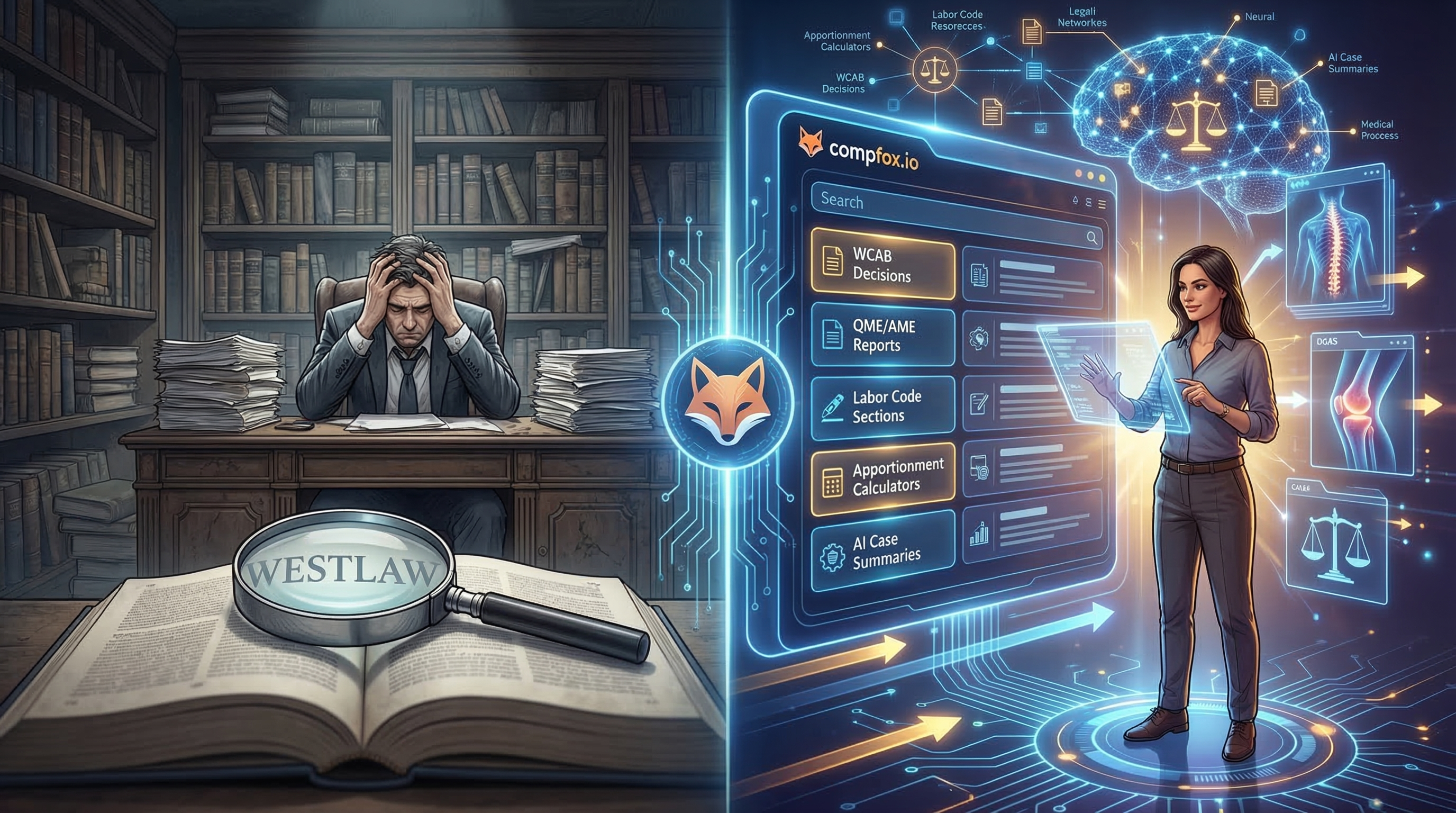
Westlaw's annual contract just hit your desk — and the renewal rate is higher than your last three settlements combined. If you're a workers' compensation attorney running a lean practice, you already know that paying five figures a year for a general-purpose research platform is one of the most expensive habits in legal ops. The question isn't whether you can afford Westlaw. The question is whether you should keep paying for a horizontal platform that wasn't built for your docket.
The workers' comp research landscape has shifted dramatically in 2026. Solo practitioners, mid-size defense firms, and applicant-side shops are all asking the same question: is Westlaw actually the best tool for researching apportionment disputes, QME credibility challenges, and En Banc WCAB decisions — or is it just the most familiar one? With purpose-built vertical AI platforms, state-specific case law databases, and free government repositories entering the mix, the answer is no longer obvious.
This guide breaks down every viable alternative for workers' comp legal research without Westlaw — from free public databases to AI-powered platforms trained exclusively on Labor Code and WC case law — so you can find the right stack for your practice, cut your research time, and stop paying for general-purpose tools that weren't built for your docket.
Westlaw is a horizontal platform built for every practice area, which means it's optimized for none in particular. Tax attorneys, immigration practitioners, and BigLaw M&A associates all share the same interface, the same indexing logic, and the same keyword-based search architecture. For workers' compensation practitioners, that's a fundamental mismatch.
Workers' comp has a uniquely dense regulatory ecosystem: Labor Code sections, WCAB panel decisions, En Banc opinions, PDRS schedules, and DWC administrative rules that generic platforms index inconsistently. When you're researching apportionment under Hikida versus Benson, or tracking the downstream treatment of a specific En Banc decision, keyword search simply cannot replicate the contextual understanding those queries demand. You'll get results — you'll just get a lot of wrong ones mixed in with the right ones, and you'll spend billable time sorting them out.
The cost-per-attorney pricing model penalizes exactly the small-to-mid-size firms doing the highest volume of WC work. Practitioners across the industry routinely cite missed citations and incomplete panel decision coverage as the core failures of general research tools [1].
Here's what makes WC research categorically different from general civil litigation research: WCAB panel decisions are not precedential but are highly persuasive — and tracking them requires a database that indexes them comprehensively. Most general platforms don't. They capture the published appellate opinions and leave the panel decisions — the decisions that define day-to-day practice — in a coverage gap.
QME and AME report cross-referencing demands document-level AI, not just case law search. When you're handling 150 open files and a QME report lands with a disputed apportionment opinion, you need to surface how similar medical conclusions have been treated across the board's recent decisions. That's not a Westlaw search. That's a purpose-built workflow.
Defense attorneys and applicant attorneys alike need rapid access to En Banc decisions to anchor arguments. A missed En Banc citation at trial is a recoverable but avoidable error — and avoidable errors are what separate efficient firms from expensive ones. Claims adjusters and legal ops leads at TPAs face a different version of the same problem: they need research outputs they can act on without a J.D., and most general platforms don't deliver that.
Westlaw's pricing bundles features most WC practitioners never use — federal circuit research, law review access, international law modules [2]. You're paying for the full library when you only work in one room. The ROI calculation shifts dramatically when you factor in time spent on searches that return irrelevant results from other practice areas. Annual contracts lock firms into tools that don't improve for their specific vertical. That's not a subscription — that's a tax.
Several credible no-cost or low-cost resources exist for WC case law and statutory research. Knowing this landscape is a competitive baseline skill in 2026. But free tools have real limitations: coverage gaps, no AI synthesis, manual cross-referencing required. The right free tool also depends heavily on jurisdiction — California DWC resources differ substantially from what's available in Texas or New York.
California's WCAB decisions are publicly available through the DWC website — coverage is broad but search functionality is rudimentary. You can find the decision if you know what you're looking for, but discovery research is painful. State labor department websites publish Labor Code text, DWC regulations, and fee schedule updates in real time, making them authoritative sources for statutory text at zero cost.
PACER provides access to federal workers' comp cases — FECA, longshore — at minimal per-page cost. The limitation across all government databases is the same: no synthesis, no citator function, no cross-referencing. These are raw data repositories, not research platforms. They're the foundation of a research stack, not the stack itself.
Google Scholar indexes appellate court decisions including workers' comp cases and is genuinely useful for finding published California Court of Appeal and Supreme Court WC decisions [3]. CourtListener (Free Law Project) offers PACER integration and a free case law database with basic search capability.
Neither platform provides the WCAB panel decision coverage that defines day-to-day WC research. They're supplemental, not primary. And neither offers AI-assisted analysis, apportionment flag detection, or QME credibility pattern recognition. For a solo practitioner on a tight budget, they're valuable. For a firm handling volume WC defense work, they're starting points at best.
Casetext with CARA AI introduced keyword-free research that marked a meaningful step forward — upload a brief and get relevant cases back [4]. Fastcase, now integrated with iManage, offers state case law coverage at lower price points than Westlaw or LexisNexis [5]. Ravel Law's visualization tools help map citation relationships, which is useful for understanding how an En Banc decision has propagated through subsequent opinions.
The critical limitation for WC practitioners: none of these platforms were trained on workers' comp specifically. They are general legal AI applied to a specialized domain. The architecture is better than Westlaw's keyword approach, but the domain coverage is still horizontal. You're getting a better general-purpose tool, not a WC-specific one.
The most common alternative practitioners consider is simply switching from one enterprise platform to the other. Worth evaluating honestly: LexisNexis and Westlaw have comparable coverage for published appellate decisions but differ in WCAB panel decision indexing depth. Pricing models differ too — LexisNexis has historically offered more flexible transactional pricing that can benefit lower-volume researchers.
But neither platform has purpose-built workers' comp AI. Both apply general NLP models to WC queries with the same domain-agnostic limitations. The switching cost question is also real: migrating research workflows, retraining staff, and renegotiating contracts is an operational burden that should require a meaningful upgrade to justify.
Lexis+ AI has made meaningful investments in generative AI research assistance — but it's trained on broad legal content, not WC-specific doctrine. Shepardizing versus KeyCite: both citator functions work comparably for appellate decisions, but neither flags WC-specific treatment patterns well. Secondary source coverage — specifically the Matthew Bender WC treatises available on Lexis — is a genuine advantage for practitioners who rely heavily on treatise research.
Bottom line: LexisNexis is a lateral move, not an upgrade, for the WC-specific research problem. If your primary pain is WCAB panel decision coverage and apportionment research depth, you'll land in the same place with a different logo on the login page.
This is the question practitioners are searching most urgently in 2026 — and the answer requires nuance, not a yes/no. General-purpose LLMs like ChatGPT and Claude can synthesize legal concepts, draft outlines, and explain doctrine at a high level. But they hallucinate case citations at a rate that is professionally dangerous.
A hallucinated citation in a trial brief or MSC statement is not a minor error. It is a sanctions risk and a credibility problem with the WCAB. The solution is not "don't use AI" — it is "use AI that was built with hallucination resistance and trained on verified WC case law." Vertical AI platforms that constrain outputs to a verified corpus solve the hallucination problem that general LLMs cannot.
WC case law is dense with near-identical fact patterns that diverge on apportionment methodology, causation standards, or IMR outcomes. General LLMs conflate them. An AI that confuses Escobedo with Ogilvie, or misattributes an apportionment holding, produces research that is worse than useless — it's actively misleading. Practitioners need AI that cites to actual WCAB decisions with real docket numbers, not plausible-sounding synthetic citations.
The verification burden of using a general LLM for WC research often exceeds the time savings, eliminating the core value proposition entirely. You're back to spending an hour confirming whether the AI gave you something real.
A purpose-built platform indexes only verified WC case law and Labor Code, so every citation it surfaces is real and retrievable. AI trained on WC-specific doctrine understands the difference between a panel decision and an En Banc opinion and weights them appropriately in its outputs. Document analysis features — reading a 200-page QME report and surfacing contested medical findings — require AI trained on WC medical-legal documents, not general legal text.
The speed advantage compounds: a platform purpose-built for WC compresses hours of research into minutes because it's not searching irrelevant practice areas. That's not a marginal improvement. That's a workflow transformation.
The smartest practitioners in 2026 aren't looking for a single Westlaw replacement — they're building a layered stack that matches tool to task. The architecture looks like this:
Tier 1: Free government databases for statute text and recent DWC rule updates — zero cost, always current, authoritative.
Tier 2: A specialized WC AI platform for case law research, QME/AME analysis, and brief support — high ROI, purpose-built, where the real competitive advantage lives.
Tier 3: A general AI assistant for drafting scaffolding, client communication templates, and non-citation-dependent work — low cost, appropriate use case.
The firms winning on efficiency in 2026 are not the ones with the most expensive subscriptions. They're the ones with the most intentional research infrastructure.
Apportionment research under Labor Code §4663 and §4664 requires a platform with deep WCAB panel decision coverage and AI that understands apportionment doctrine — not a general keyword search. QME report analysis and cross-referencing medical findings requires document AI, not case law search. This is where general platforms fail most visibly and most expensively.
Researching the current state of an En Banc decision requires a citator that tracks WC-specific treatment, not just general citation history. Drafting settlement letters and C&R agreements, on the other hand, is an appropriate use case for general AI with human review — no citation risk, high repetition, good automation target.
A solo WC practitioner handling 150+ files does not have the same research budget as a BigLaw insurance defense group. The tool selection calculus is different. Calculate your true research cost: hours per month on case law research multiplied by your effective hourly rate equals the maximum you should rationally pay for a research platform. For most solo and small firm practitioners, that number is far lower than a Westlaw renewal.
Vertical AI platforms available at a fraction of Westlaw's price point can deliver superior WC-specific results — the ROI case is straightforward once you run the math. Free trial access to purpose-built platforms lets you benchmark actual research output before committing to anything.
Here's a step-by-step research process that doesn't touch Westlaw or LexisNexis — jurisdiction-aware, actionable, and built for California WCAB practice.
Pull the relevant Labor Code section directly from the California Legislative Information website at leginfo.legislature.ca.gov — authoritative, free, always current. Identify the specific subdivision at issue. LC §4660.1(c)(1) versus (c)(2) matters enormously in permanent disability disputes, and conflating them is a research error that cascades. Note any recent amendments — DWC rulemaking can change operative language in ways that aren't immediately reflected in secondary sources.
Use a purpose-built WC AI platform to query the specific legal issue — apportionment, causation, IMR, SIBTF liability, whatever the case demands. Identify any En Banc WCAB decisions on point first. These are the closest thing WC has to binding precedent at the board level, and anchoring your argument in En Banc authority is the difference between a persuasive brief and an expensive one.
Surface relevant Court of Appeal and Supreme Court decisions that have addressed the issue. Then flag high-volume panel decisions that represent the practical consensus position even without precedential weight. That consensus is what your opposing counsel is citing, and you need to know it.
Confirm every citation is real and the holding is accurately characterized. This is where hallucination-resistant AI earns its value — and where general LLMs will cost you. Check whether subsequent decisions have distinguished, limited, or expanded the holding you're relying on. Cross-reference medical findings in QME/AME reports against the legal standard your research has identified. The gap between what the QME concluded and what the legal threshold requires is often exactly where cases turn.
Build your research memo with full citations and a clear chain of authority. If you're ready to put this workflow into practice, Start Researching with CompFox — it's the only platform purpose-built for exactly these steps.
Westlaw Edge offers a limited free access tier through some law school alumni networks and bar associations — coverage is restricted and generally insufficient for production research. Law school library access provides full Westlaw access at no direct cost if you maintain adjunct faculty or alumni credentials with an active affiliation. For most practitioners in active practice, "free Westlaw" is either unavailable or too restricted to rely on. The more productive question is whether purpose-built alternatives deliver better ROI at a lower price point — and in 2026, they do.
Insurers and self-insured employers do negotiate directly with unrepresented injured workers, but the research asymmetry is significant. This question signals applicant-side practitioners and legal ops leads at TPAs — both of whom benefit from faster, more accurate research on settlement valuation. The legal research question embedded here is about knowing the applicable PD rating, apportionment exposure, and future medical liability. These are precisely the areas where specialized AI tools provide a material advantage over manual research or general platforms.
For general legal research, Westlaw and LexisNexis are broadly comparable with different UI preferences and pricing structures. For workers' comp specifically, neither platform's AI is trained on WC doctrine — the differences between them matter less than the gap between both of them and a purpose-built WC platform. Loislaw and VersusLaw are lower-cost options with significantly reduced coverage, appropriate for budget-constrained practitioners doing limited research but not for high-volume WC practices where missed citations carry real professional and financial risk [3].
Workers' comp practitioners in 2026 have more research optionality than at any point in the history of the practice — and the best options are no longer the most expensive ones. Free government databases handle statute research. Purpose-built AI platforms with hallucination-resistant architecture handle case law research, QME/AME analysis, and brief support faster and more accurately than Westlaw for WC-specific work. General AI assistants handle drafting scaffolding. The practitioners and firms that recognize this and build intentional research stacks will outpace the ones still paying premium prices for horizontal tools that weren't built for their docket.
The fastest firm wins — and speed in 2026 means the right AI, not the biggest subscription.
Stop letting a general-purpose platform slow down your workers' comp practice. CompFox is purpose-built exclusively for WC — trained on WCAB decisions, Labor Code, and the medical-legal documents that define your caseload. Start Researching with CompFox today and see what your research workflow looks like when the tool actually speaks your language.
Workers comp legal research without Westlaw is entirely feasible using a combination of free government repositories, specialty databases, and AI-powered tools. Start with free public resources: the California WCAB's official website publishes panel decisions and En Banc opinions at no cost, while Google Scholar indexes state and federal case law for free. The DWC website provides access to administrative regulations, PDRS schedules, and Labor Code text. For more structured research, consider platforms like Fastcase (often included free through state bar memberships), Casetext, or vLex, which offer affordable subscription tiers. Purpose-built workers' comp AI platforms have also emerged in 2026 that are trained specifically on Labor Code sections, WCAB decisions, and WC case law — delivering faster, more accurate results for apportionment disputes, QME credibility issues, and treatment disputes than general-purpose tools. The most effective approach combines a free government source for primary law, a low-cost case law aggregator for citator functions, and a WC-specific AI tool for contextual research queries. Many solo and small-firm practitioners find this stack costs a fraction of Westlaw while outperforming it for their specific docket.
Yes, there are multiple strong alternatives to Westlaw, especially for workers' compensation practitioners. The most widely used paid alternatives include LexisNexis, Casetext (now part of Thomson Reuters but separately priced), vLex, Fastcase, and Loislaw. For workers' comp specifically, vertical AI platforms trained on WC-specific case law have become a compelling alternative in 2026, offering contextual search across WCAB panel decisions, En Banc opinions, and Labor Code sections that general platforms like Westlaw index inconsistently. Free alternatives include Google Scholar, CourtListener (via PACER), and official state DWC or WCAB websites. Many state bar associations also provide Fastcase access at no additional cost to members. The right alternative depends on your practice volume, jurisdiction, and the types of issues you research most — apportionment, medical-legal disputes, AOE/COE challenges, or penalty petitions. For high-volume WC practitioners, a purpose-built vertical database will typically outperform Westlaw at a significantly lower price point.
Yes, an insurance carrier can and often will offer a workers' comp settlement without a lawyer involved — but whether that offer is fair is a different question. Unrepresented injured workers typically receive lower settlement offers because adjusters know they may not fully understand the value of their claim, including future medical care costs, permanent disability ratings, and apportionment arguments. In California, any Compromise and Release or Stipulated Award must be approved by a Workers' Compensation Administrative Law Judge, who is required to review settlements involving unrepresented applicants more carefully — but this safeguard is imperfect. Studies consistently show that represented workers receive higher average settlements than unrepresented claimants. If you have a disputed injury, a complex medical history, or a significant permanent disability rating, consulting with an applicant-side workers' comp attorney is strongly advisable before accepting any offer. Most applicant attorneys work on contingency, meaning no upfront cost to the injured worker.
Yes, there are meaningful differences between these platforms, particularly for workers' comp legal research. Westlaw and LexisNexis are the two dominant full-service platforms with the broadest content libraries, robust citator tools (KeyCite and Shepard's respectively), and comprehensive secondary sources — but both are expensive and built as horizontal tools covering all practice areas. Loislaw, owned by Wolters Kluwer, is a lower-cost alternative with solid primary law coverage but thinner secondary source depth and less sophisticated search functionality. VersusLaw is an economical option for basic case law access, though its coverage of administrative decisions and specialty tribunal opinions like WCAB panels is limited. For workers' comp legal research without Westlaw specifically, none of these general platforms index WCAB panel decisions, DWC administrative rules, and Labor Code nuances as thoroughly as a purpose-built WC database. In 2026, the most significant differentiator is AI-enhanced contextual search — platforms that understand workers' comp terminology natively, like the difference between apportionment under Hikida versus Benson, will outperform keyword-based systems regardless of content volume.
Using free tools effectively for workers' comp legal research without Westlaw requires a structured approach. First, use the California DWC and WCAB websites as your primary source for administrative decisions, En Banc opinions, and regulatory text — these are authoritative and free. Google Scholar is useful for searching published appellate decisions and can surface relevant Court of Appeal and Supreme Court cases interpreting the Labor Code. CourtListener via PACER provides access to federal court decisions affecting WC-related claims. For citator functions — verifying whether a case is still good law — free tools are limited, so consider a low-cost subscription to Fastcase or Casetext for citator access only. Supplement free research with targeted searches on legal blogs, law review articles, and DWC educational materials that summarize recent trends. The key limitation of free tools is inconsistent indexing of WCAB panel decisions, which are highly persuasive in practice. For practitioners handling high volumes of WC cases, investing in a specialty WC database or AI research tool for panel decision research, while relying on free sources for statutory and published appellate law, creates an efficient and cost-effective research stack.
ChatGPT can perform basic legal document analysis tasks — summarizing content, identifying key provisions, flagging potential issues, and drafting responsive arguments — but it has significant limitations for serious workers' comp legal research. The most critical limitation is hallucination: ChatGPT can generate plausible-sounding case citations that do not exist, which is a professional responsibility risk if those citations end up in filings. As of 2026, general-purpose large language models like ChatGPT are not reliably trained on current WCAB panel decisions, DWC administrative updates, or recent Labor Code amendments, meaning their outputs may be outdated or jurisdictionally inaccurate. Purpose-built legal AI platforms differ from ChatGPT in that they are grounded in verified, current legal databases — they cite real cases with retrievable sources rather than generating synthetic citations. For workers' comp practitioners, using ChatGPT as a brainstorming or drafting aid while verifying all legal authority through a reliable database is a reasonable workflow. Using it as a standalone research tool for case citations or regulatory interpretation is not recommended without independent verification.
There is no true free version of Westlaw for professional legal research. Westlaw offers limited free access through Westlaw Edge for law students at participating schools and provides some free preview access for new subscribers, but practicing attorneys do not have access to a no-cost tier with meaningful research functionality. Some public libraries offer limited Westlaw access, and certain court self-help centers provide restricted access for pro se litigants. For workers' comp legal research without Westlaw, practitioners have better free options elsewhere: the WCAB website, DWC official portal, Google Scholar, and CourtListener all provide genuine no-cost access to primary legal materials. State bar Fastcase benefits are another underutilized free resource — many bar associations include full Fastcase access in membership dues, which covers case law, statutes, and regulations. If your research needs are primarily workers' comp focused, these free and low-cost alternatives often provide better coverage of WCAB decisions and California-specific WC materials than a general Westlaw subscription would.
For general legal research, LexisNexis and Westlaw are closely matched, with practitioners often preferring one over the other based on familiarity rather than objective capability differences. Both offer strong citator tools (Shepard's for Lexis, KeyCite for Westlaw), broad case law coverage, and secondary sources. However, for workers' comp legal research specifically, neither platform has a decisive advantage over the other — and both share the same core limitation: they are horizontal platforms not optimized for the workers' comp practice area. Both inconsistently index WCAB panel decisions, which are non-precedential but highly persuasive in California WC practice. Neither is purpose-built to understand Labor Code nuances, PDRS schedules, or the specific procedural posture of WCAB proceedings. For practitioners focused exclusively on workers' comp, the more relevant comparison in 2026 is between these general platforms and vertical WC-specific research tools or AI platforms trained on WC case law. In that comparison, a specialty tool will typically deliver more accurate and relevant results for WC-specific queries at a lower cost than either Westlaw or LexisNexis.
[1] https://www.logikcull.com/blog/5-useful-online-legal-research-tools-not-made-westlaw-lexisnexis. logikcull.com. https://www.logikcull.com/blog/5-useful-online-legal-research-tools-not-made-westlaw-lexisnexis
[2] https://libguides.law.uconn.edu/c.php?g=345460&p=2327945. libguides.law.uconn.edu. https://libguides.law.uconn.edu/c.php?g=345460&p=2327945
[3] https://www.cloudlex.com/tips-and-tricks/free-and-paid-legal-research-tools-for-attorneys/. cloudlex.com. https://www.cloudlex.com/tips-and-tricks/free-and-paid-legal-research-tools-for-attorneys/
[4] https://huntersquery.byu.edu/casetext-with-cara-ai-keyword-free-legal-research/. huntersquery.byu.edu. https://huntersquery.byu.edu/casetext-with-cara-ai-keyword-free-legal-research/
[5] https://legalresearch.usfca.edu/EmploymentAndLaborLawResearch/LawyersTools. legalresearch.usfca.edu. https://legalresearch.usfca.edu/EmploymentAndLaborLawResearch/LawyersTools
The landscape of apportionment in California workers' compensation law is undergoing a subtle but significant transformation.
Navigate California unemployment benefits with our complete 2026 guide. Learn eligibility requirements, weekly benefit amounts, claims process, and how the EDD determines your entitlements. Essential for claimants, employers, and legal professionals.
Apply these legal strategies instantly. CompFox helps you find decisions, analyze reports, and draft pleadings in minutes.